
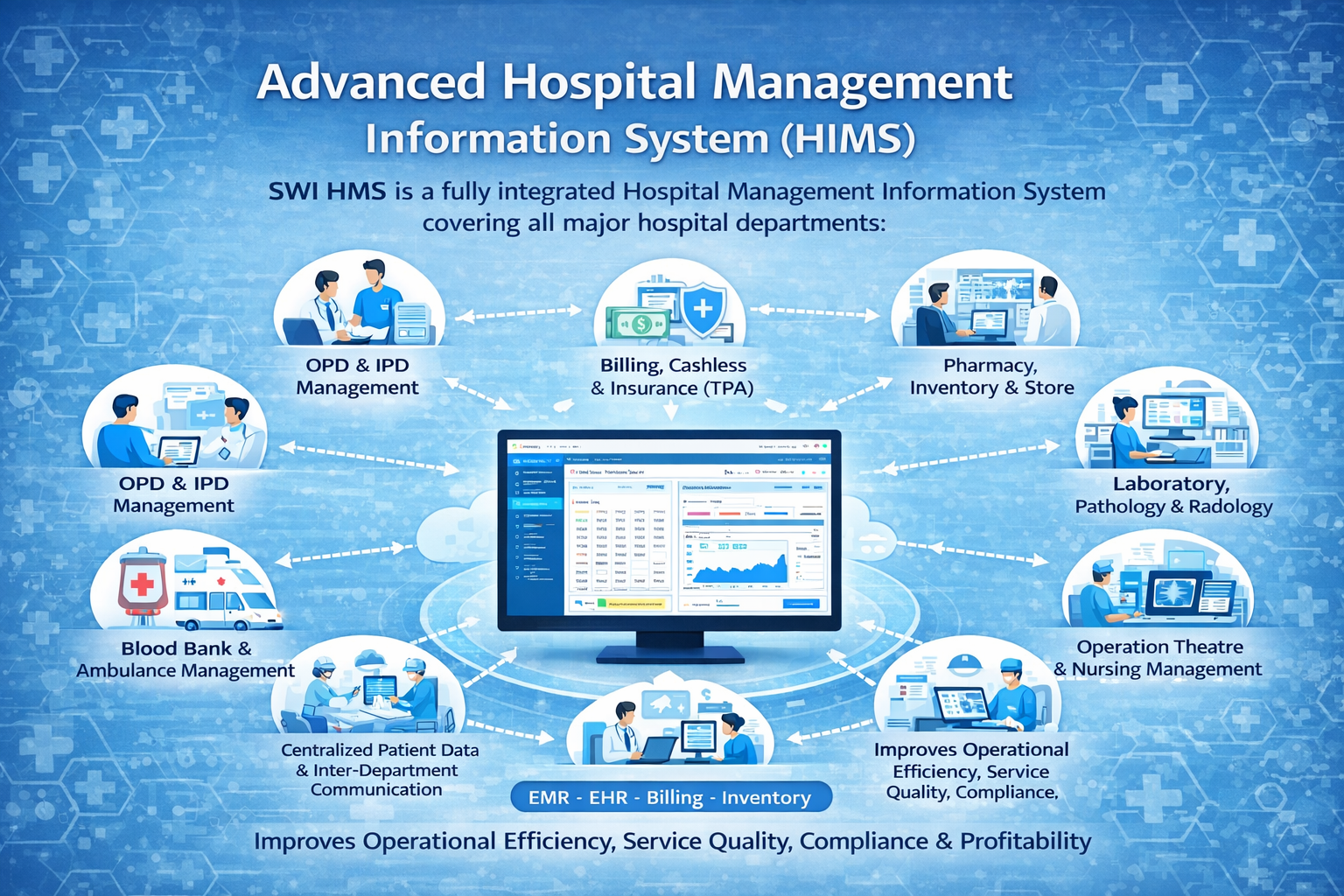
In today’s fast-paced healthcare environment, hospitals and clinics need a centralized digital solution to manage clinical, administrative, and financial operations efficiently. A Hospital Information System (HIS) is designed to streamline hospital workflows, improve patient care, and enhance operational efficiency through automation.
This blog explains what a hospital information system is, its core features, benefits, and why healthcare organizations should adopt a modern HIS solution.
What Is a Hospital Information System?
A hospital information system is an integrated software platform that manages all aspects of hospital operations, including patient records, OPD/IPD management, billing, laboratory, pharmacy, and reporting.
By digitizing hospital processes, an HIS eliminates manual paperwork, reduces errors, and enables seamless communication between departments.
Core Modules of a Hospital Information System
A complete hospital information system consists of multiple interconnected modules working together in real time.
1. Patient Registration & Appointment Management
- Centralized patient database
- OPD appointment scheduling
- Fast patient search and visit history tracking
2. OPD & IPD Management
- Doctor consultations and clinical notes
- Admission, discharge, and transfer workflows
- Bed and ward management
3. Billing & Accounts Management
- OPD and IPD billing automation
- GST-compliant invoicing
- Insurance, TPA, and reimbursement processing
4. Pharmacy Management
- Medicine inventory control
- Batch and expiry tracking
- Purchase and sales management
5. Laboratory & Diagnostic Management
- Test order management
- Lab report generation
- Integration with patient medical records
6. Reports & Analytics
- Daily revenue and expense reports
- Department-wise performance analysis
- Management dashboards for decision-making
These modules make a hospital information system essential for hospitals, clinics, and diagnostic centers of all sizes.
Benefits of Implementing a Hospital Information System
Adopting a modern HIS delivers measurable benefits across hospital operations:
- ✅ Faster patient service and reduced waiting time
- ✅ Improved accuracy in billing and clinical records
- ✅ Better coordination between departments
- ✅ Secure storage of medical data
- ✅ Improved hospital productivity and profitability
A well-implemented hospital information system enhances both patient satisfaction and administrative efficiency.
Hospital Information System vs Traditional Hospital Management
| Traditional Process | Hospital Information System |
|---|---|
| Paper-based records | Digital medical records |
| Manual billing | Automated billing |
| Department silos | Integrated departments |
| Delayed reports | Real-time analytics |
This transformation enables hospitals to deliver better care with fewer resources.
Why Choose a Modern Hospital Information System?
A modern HIS should be:
- Scalable for future growth
- Easy to use for doctors and staff
- Secure and compliant with healthcare standards
- Customizable based on hospital requirements
Choosing the right system ensures long-term operational success.
Best Hospital Information System for Healthcare Providers
If you are looking for a reliable and feature-rich hospital information system, choosing a trusted provider is critical. A professional HIS offers end-to-end hospital automation, seamless integration, and dedicated support.
👉 Explore a complete Hospital Information System
Conclusion
A hospital information system is no longer optional—it is a necessity for modern healthcare organizations. From patient care to billing and analytics, an HIS transforms hospital operations into a connected, efficient ecosystem.
Hospitals that invest in the right hospital information system gain improved efficiency, transparency, and better patient outcomes.
PEOPLE ALSO ASK (PAA)
What is the purpose of a hospital information system?
A hospital information system is designed to streamline hospital operations by integrating patient management, billing, pharmacy, laboratory, and reporting into one system, improving efficiency, accuracy, and patient care.
What is the difference between HIS and HMS?
HIS (Hospital Information System) focuses on integrated hospital-wide data and clinical workflows, while HMS (Hospital Management System) often emphasizes administrative and operational management. Modern systems usually combine both into a single platform.
Is hospital information system software cloud-based?
Yes, most modern hospital information systems are cloud-based, offering secure remote access, automatic updates, data backup, and scalability for growing healthcare organizations.
How much does hospital information system software cost?
The cost of hospital information system software depends on hospital size, number of modules, deployment type (cloud or on-premise), and customization requirements. Many providers offer demo-based pricing.
Can a hospital information system be customized?
Yes, a hospital information system can be customized based on hospital workflows, specialties, reporting needs, and integration requirements.
